Language acquisition
At Honey Monsters, children pick up English as a bonus alongside carefully planned, high-quality early childhood education.
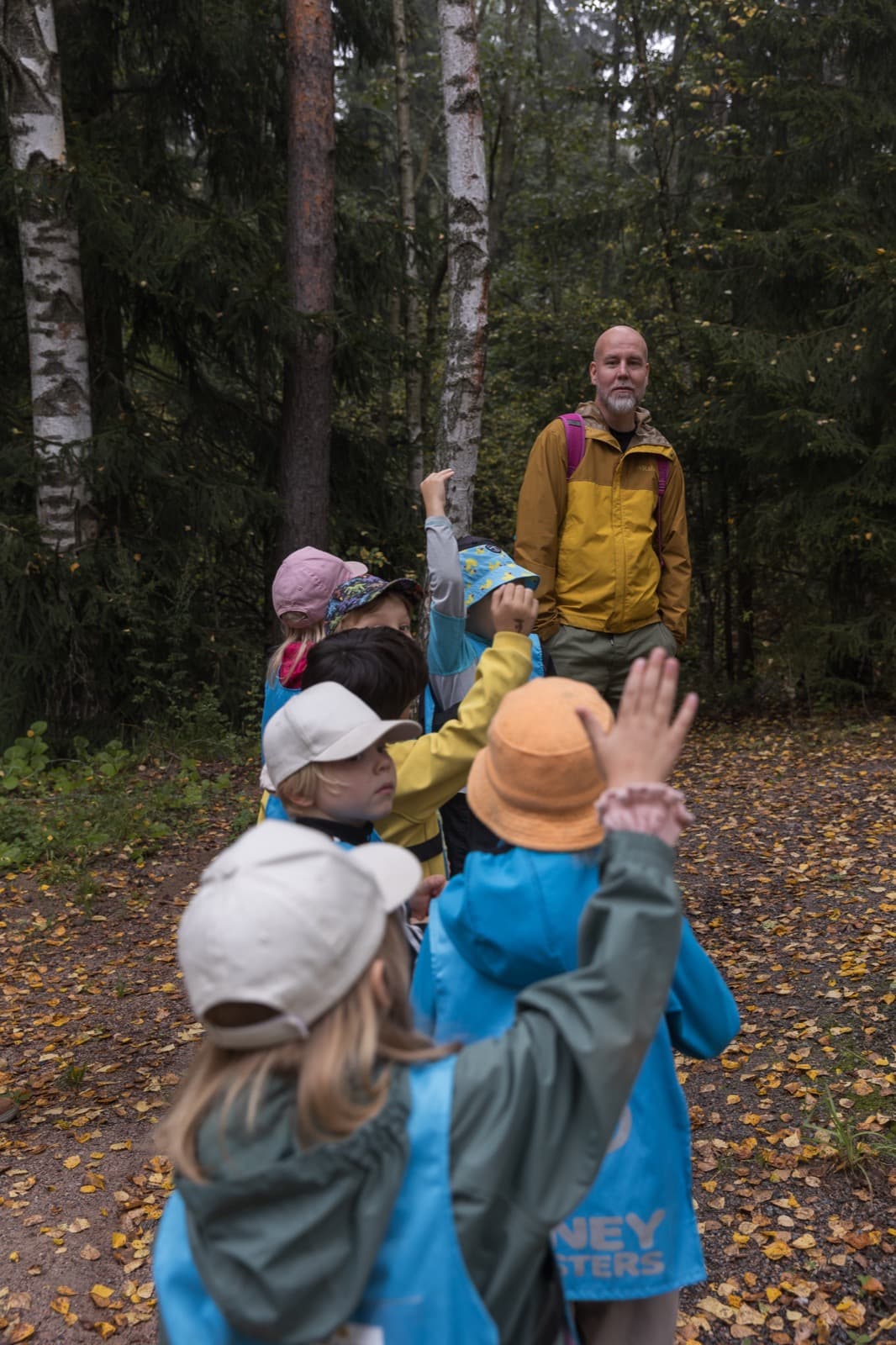
First year
“Beginners”When a child joins our kindergarten in the year they turn four, they begin acquiring English without any previous knowledge of the language. Of course, some of our children are bilingual and may already speak some English.
In our experience, monolingual children quickly start to understand phrases that are repeated in the same way, often within the first couple of weeks. Usually, within three months they understand more than just the basic phrases. In the first year, the children's language skills are still closely tied to what they do at the kindergarten. They may not understand if someone asks them what "art" is in Finnish, but if you say to them, "Go to the Art Center, please", they know exactly what is meant.
Second year
“Juniors”In their second year, at the age of five, children start to produce more language themselves. Part of a sentence is often in Finnish, but research shows that this is a natural part of the process. The phenomenon is called code-switching. Children understand the overall meaning, though not necessarily every detail.
We have noticed that when a child starts at our kindergarten at the age of five, within a year they catch up with the language skills of friends who started at four. This is probably because five-year-olds are more interested than four-year-olds in learning a new language. They also compare themselves with others and are keen to pick up as much as their friends.
Third year
“Preschoolers”In the pre-primary year, children are expected to speak considerably more English. They are encouraged to try forming whole sentences in English. We ask families to remind their child to use only Finnish sentences at home.
Children understand almost all of the language used at the kindergarten, quickly notice new words and ask what they mean.
Carefully considered methods
Children's language skills at Honey Monsters do not develop by themselves, even though it may seem that way to parents. The kindergarten is designed as an English-language environment. We have thought our methods through carefully so that the children enjoy themselves and have meaningful things to do – and the language skills come along as a bonus.
Our staff make sure that we offer children the right kind of language at the right time for their stage of development. Children should be challenged with new language just enough – not too much and not too little – so that learning feels effortless. On the other hand, if children are not encouraged to use English, they will understand it when it is spoken but mostly speak Finnish themselves.
An English-language environment
Honey Monsters is an English-language environment where children hear Finnish only from other children. The kindergarten also supports the development of Finnish, for example through outings to Finnish-speaking places and through Finnish-language homework for pre-primary pupils, which they do together with a parent.
The core idea of Early Total Immersion is language roles: the kindergarten teachers consistently speak English with the children. With parents, the teachers speak Finnish.
Supporting the mother tongue at home is important
The development of a child's mother tongue is extremely important. The immersion method highlights the parents' role in supporting their child's own mother tongue. At home, it is important to make sure that, in addition to spoken language, the child is in daily contact with Finnish read aloud from books. We recommend reading, rhyming and singing a lot in Finnish at home so that the child's skills keep developing in their first language (Finnish).